










Briefly on world economy
The idea that today there exist several separate national economies which exist relatively independently and autonomously of one another is erroneous. The various national home markets of the various different countries have been combined into one large world market, which is the sphere of world economy. The creation of the world market and world economy alongside it is the product of capitalist development. Prior to capitalism, the various local and national economies were self-replicating and due to the primitiveness of the productive forces and of the cultural level, there was little in the way of commerce except of the elementary kind. Today, after mercantile, industrial and recent financial developments in the world economy, the idea of the separation of the various national economies has been reduced to mere abstraction.
Furthermore, capitalist world economy is premised on the production and circulation of commodities. Capitalist commodity production is distinguished from pre-capitalist elementary commodity production due to the former being the result of the separation of the means of production from the producer, which compels the commodities so produced to be foremost destined for the market and only then be objects of use. This implies exchange, which, as Marx explains in Capital, is the process by which a commodity is transformed from a non use-value into a use-value through movement of the commodity from the hands of one participant in the exchange to the other and vice versa.
The reason for this international exchange is two-fold. On the one hand, due to uneven development — which is itself a product of deeper forces — it becomes impossible for all countries to produce all commodities necessary to maintain the cultural, technical and social level and to expand it, which compels the exchange of commodities produced “here” for commodities produced “there”. On the other hand, the division of labor is a necessary law of capitalism, which continually maintains and reproduces on a higher level the division of labor. The division of labor between town and country, on a national scale has today, under imperialism, become reproduced on a higher basis as the division between an international town and country. With metropoles such as China, The United States, Germany, Russia and Britain being the leading powers the international “towns” whereas the other countries have become the international “countryside”.
This leads to a particularity which modern socio-economic life presents. Capitalism presents itself as the domination of the country by the towns. It is the highest point of the antithesis between town and country. Given the reproduction on a significantly higher level of the antithesis between town and country, it comes as little surprise that today we find the international metropoles dominating and extracting massive super-profits from the countryside.
It proceeds from this then that there is also an international division of labor. What certain detachments of the world economy produce vis-a-vis other detachments has become a question of paramount significance. The inseparability of any one part of the world economy presents for the Nepali communists in particular great challenges. What we seek to investigate here is precisely how this division of labor manifests in Nepal. What is Nepal’s particular role in the world economy and what does this entail for our revolution?
The modern international division of labor
The fact that there exists an international division of labor is undeniably true. Social production has become transformed from a local and national enterprise into one of an international character. Every commodity we consume today undergoes an international i.e., internationally social and cooperative process of production. This is as much true for intangible commodities as it is for tangible ones. Services themselves are outsourced to that place where the cost of the appropriate labor power is lowest. Many software developers outsource their projects to India, Nepal etc. where the process of developing the software really occurs.
Given this international division of labor and international commerce which rests on this division and indeed aggravates it, we can observe a general tendency in the world economy. What position in the social division of labor different states occupy is a necessary concern for us. This is since it is necessary to understand the general position where different countries exist to make sense of the position of Nepal in this international economic system.
Looking at the modern division of labor between different states can give us a general idea of where they belong in the social process of production. Before elucidating these, it must be noted that this is not a strict and formal division. Every state to some extent or another has aspects of all of these categories. It is only a general tendency within the world economy by which these states are divided as such.
These are:
- Rentier-states
Lenin in his Imperialism The Highest Stage of Capitalism, notes that, “More and more prominently there emerges, as one of the tendencies of imperialism, the creation of the “rentier state”, the usurer state, in which the bourgeoisie to an ever-increasing degree lives on the proceeds of capital exports and by “clipping coupons”.” The ruling bourgeoisie of these states, as Lenin notes, live simply by the export of finance-capital.
Even by Lenin’s time, the ruling capitalists — the financial oligarchy — of the “Great Powers” had become an essentially superfluous class, clinging to existence by the greatest brutality, savagery and barbarism both against the national proletariat and against the international proletariat. The majority of the earnings of capital of these states comes not from production per se, but from “skimming the milk” of the production process. Today, The United States is distinguished as the shining example of the rentier-state, Britain too is another example of a rentier-state. China, Germany and the other world powers of today also export finance-capital, but their role is limited compared to that of American imperialism; though, American hegemony is gradually collapsing.
Under the Bretton-Woods system under which we live, it is American imperialism in particular that is able to get the greatest loot from the deprived countries. Through institutions such as The International Monetary Fund and the World Bank, the United States is able to project its economic domination over all other countries. The ruling capitalists of the United States then through the destruction that American imperialism causes rakes in unfathomably large amounts of money.
- Extractionary-states
The existence of these states in the world market serves, as the name implies, the extraction of raw materials and resources. Their purpose in the economy is to fuel the production process by supplying it with that which is necessary to produce finished commodities. These include rare earths, minerals, rubber and other such raw materials. The extraction of resources from nature i.e., the most crude type of production, is what the main driver of the economy is in these states.
Many of the countries in the African and Asian continents fall into this category. These include, most famously the Democratic Republic of Congo, Nigeria etc.
Lenin quoting Kestner says, “[…] We must add that the industries which process raw materials (and not semi-manufactures) not only secure advantages from cartel formation in the shape of high profits, to the detriment of the finished goods industry, but have also secured a dominating position over the latter, which did not exist under free competition.” Those who go on to process raw materials are able to secure their domination. What is the condition of those places from where these raw materials are extracted in the first place? Absolute destitution.
In the modern world economy, even the capitalists who employ those who ultimately extract these raw materials are paid significantly less than those capitalists of the imperialist states who are able to purchase these raw materials from them and sell at monopolist prices. This then, “trickles down” to the common worker of these countries who are forced to survive on next to nothing.
- Industrialist-states
As the name suggests these are those states which are highly industrially developed. It is true that even rentier states are industrialized, but it is in industrialist-states where the ruling capitalists’ profits come mainly from the typical industrial production process as such. Bangladesh and Vietnam are examples of such industrialist-states. China too, was an industrialist state as is transitioning toward becoming a rentier-state.
The question then arises as to which category Nepal falls under. The Nepali ruling bourgeoisie does not live on usury as the capitalists of the rentier-states do, nor do they profit from the expropriation of raw materials, nor really from industry. The Nepali capitalist class produces for the world economy a special commodity which it sells daily. It produces that commodity which is the source of value, the Nepali capitalists produce the proletariat. It produces this not for its own use as such, but for sale. Nepal thus acts as the reserve proletarian army of the world. This is its distinguishing quality.
Nepal and the world reserve army of labor
One of Nepal’s finest modern Marxists, Shashwat Regmi, on this issue writes in his article on the transnational proletariat: “The youths of Nepal have been the biggest and most successful export for the government since quite a while ago. […] it’s now a normality for families to brag about exporting their beloved children being sent away as wage-slaves.” This is a peculiar condition of our economy. In the fiscal year 2023/2024 25-26% of Nepal’s GDP consisted of remittances. This makes Nepal one of the countries most dependent on remittances. If we look at this as a percentage of households affected, we see as per the 2021 census that, 23.4% of 6.6 million total households – shows that nearly one in every four households in Nepal has a family member living abroad. This number is certain to increase in the upcoming census given that in just the year 2024 alone 856,422 individuals left Nepal for foreign employment.
The numbers by themselves mean little when separated from the earlier explanation of modern imperialism. However, as has been noted, the international division of labor has now created an international town which is the central point around which the international countryside revolves. The old dynamics of capitalism which Marx laid out in Capital are playing out today only on a significantly higher level. These numbers show only one thing, that Nepal is part of the international countryside, and is part of that international countryside which is to be decimated by the innate antagonisms found within capitalism.
Marx writes in the first sentence of Chapter 31 of Capital Volume I: “The expropriation and expulsion of the agricultural population, intermittent but renewed again and again, supplied […] the town industries with a mass of proletarians entirely unconnected with the corporate guilds and unfettered by them” this is a process we see playing out on an international scale, we see this occurring rather literally in Nepal. Since neoliberal reforms were embraced fully in 1990 to today, we see a drop in the percentage of the population engaged in agriculture from 77.7% in 1991 to 62% in 2023. Likewise, the percentage of the population employed abroad experienced a percentage change of 115% between the years 1991 and 2021. We see then that there is an exodus of the population from the old rural lives, who are transformed into proletarians who then move abroad.
Indeed there are economic, political and social causes for this. The study entitled Drivers of Skilled Workforce Migration From Nepal discusses these at some length. These reasons generally include: the saturation of the Nepali labor market, relatively high payment abroad vis-a-vis in Nepal, political instability in Nepal, migration being seen as the rational or normal choice etc. etc. However, this alone does not answer why these conditions have been created. The most succinct and accurate expression of why these conditions have been created is found in the aforementioned article by Shashwat Regmi where he writes: “This leads to the manpower industry, the politicians who support them and the banks that profit from remittance have to have a clean, shared class interest to keep shipping off more wage slaves every year.” This is true. Of the surplus-value created by the workers abroad, part of it is paid to manpower middlemen; of the wage which the worker receives a large percent is sent back as remittance which becomes the basis of money circulating in Nepal’s banking sector, which is itself, through the holding system, through the fact of the dilution of ownership by Public Limited Companies creates a financial oligarchy in Nepal — which is directly or indirectly at the behest of the “foreign” bourgeoisie — or, as in the case of Everest Bank is controlled directly by “foreign” financial oligarchs.
All of this leads to the further incentivization for the export of labor power for the enrichment of all participants in this economic process — of all capitalists that is! There is no doubt that the capitalists of the country where this cheap workforce is sent, which further increases competition and dims solidarity among proletarians there benefit immensely. Nor is there doubt that the manpower middlemen, the banks, the state which is the collective interest of the bourgeoisie personified all take great pleasure in this plunder, not only of natural resources, but particularly of people, but for the workers themselves? There is nothing but struggle.
It is no doubt that the selling of labor power sanctioned by the authority of the state is itself of great benefit for the world bourgeoisie, it must also be ascertained what other ways that this benefits the world bourgeoisie, this is what must now be addressed.
Consumptionism: Further Implications for The Home Market
The usual Maoist formulation sees the bourgeoisie of a semi-colonial country split into two: the national “middle” bourgeoisie and the comprador bourgeoisie. Mao writes in On The People’s Democratic Dictatorship that
“The national bourgeoisie at the present stage is of great importance. Imperialism, a most ferocious enemy, is still standing alongside us. China’s modern industry still forms a very small proportion of the national economy. No reliable statistics are available, but it is estimated, on the basis of certain data, that before the War of Resistance Against Japan the value of output of modern industry constituted only about 10 per cent of the total value of output of the national economy. To counter imperialist oppression and to raise her backward economy to a higher level, China must utilize all the factors of urban and rural capitalism that are beneficial and not harmful to the national economy and the people’s livelihood; and we must unite with the national bourgeoisie in common struggle.”
In the Analysis of Classes in Chinese Society, he writes,
“The middle bourgeoisie, by which is meant chiefly the national bourgeoisie, is inconsistent in its attitude towards the Chinese revolution: they feel the need for revolution and favour the revolutionary movement against imperialism and the warlords when they are smarting under the blows of foreign capital and the oppression of the warlords, but they become suspicious of the revolution when they sense that, with the militant participation of the proletariat at home and the active support of the international proletariat abroad, the revolution is threatening the hope of their class to attain the status of a big bourgeoisie. Politically, they stand for the establishment of a state under the rule of a single class, the national bourgeoisie.”
We see that Mao himself viewed the so-called national bourgeoisie as a class that was progressive in the struggle against imperialism though still vacillating. Perhaps there did exist such a divide between that bourgeoisie which serves imperialism and that bourgeoisie which does not at that time in China. To add to that, China was semi-feudal, so a democratic revolution would have been progressive as well as per such an analysis. However, today, in Nepal, when we look at the ruling capitalist class, such a division between that part of the bourgeoisie which is a detachment of world imperialism and that part which is not, simply does not exist. The whole bourgeoisie to some extent or another is interlinked and interconnected to the world market. The whole bourgeoisie of Nepal lacks the sovereignty which would enable them to struggle against imperialism without risking their own stability.
To accumulate capital i.e., reproduce on an extended scale, the capitalist requires good connections with other businesses, with the state, with banks etc. etc. and any capitalist which is truly a capitalist is necessarily integrated into this system and thereby the system of imperialist world economy. There is no national bourgeoisie today. Today the struggle, even a national-democratic struggle, is against the whole bourgeoisie.
In the usual Maoist formulation, it is assumed that the comprador bourgeoisie do not help develop the backward economy whereas the national bourgeoisie are “beneficial and not harmful to the national economy and the people’s livelihood” that they help to develop the productive forces and lay the foundation for the struggle for social emancipation. However, industry today is controlled partially or to a large extent by the banks, there is an increasing coalescence between industrial and banking capital. Most small and medium sized enterprises find it difficult to finance their enterprise, the successful firms, which can be called of a capitalist orientation are those who have ties to banking capital and form the basis of finance-capital. And, as we have already mentioned this finance-capital is itself tied to the interests of the imperialists i.e., of the “Great Powers.”
The so-called national bourgeoisie of Nepal then, has no ability whatsoever to launch a challenge against imperialism even if they wanted to. They are completely integrated into the world economic system.
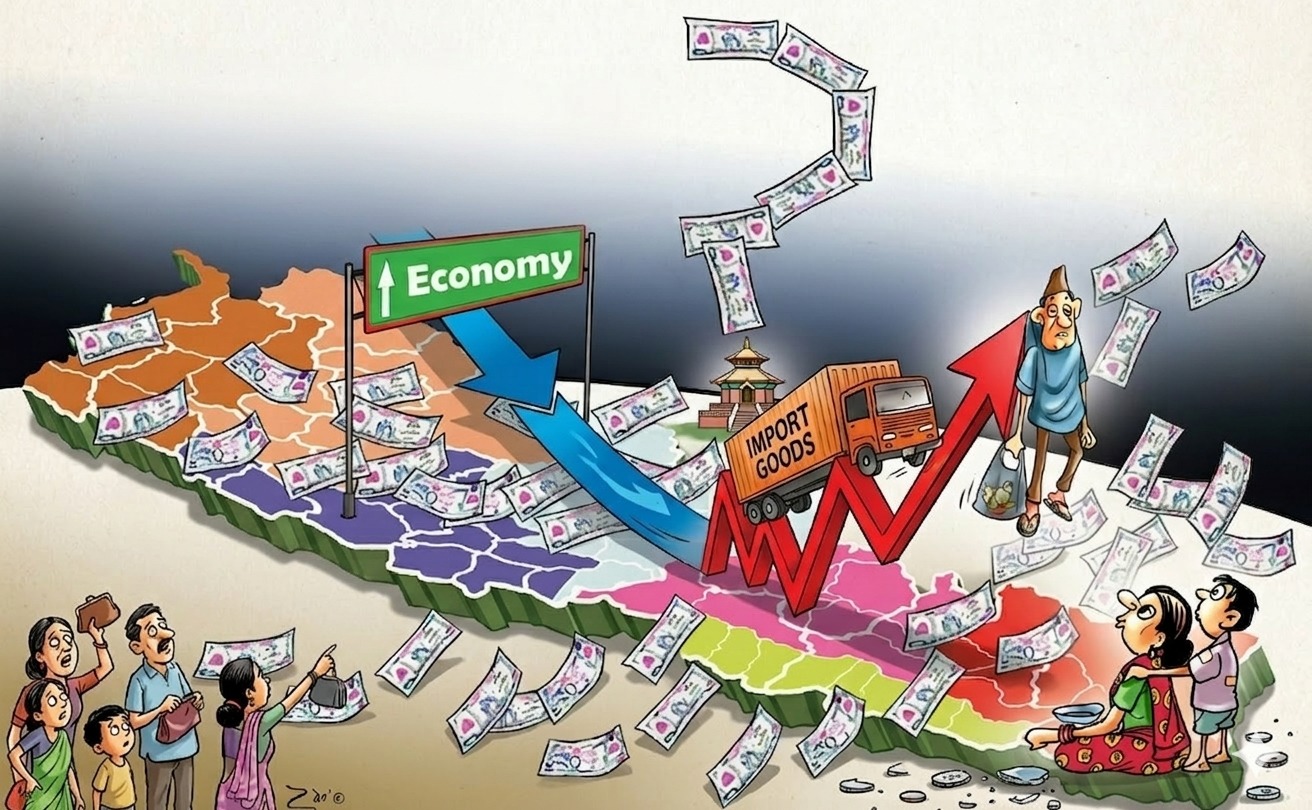
It comes as no surprise then that the role played by the bourgeoisie in Nepal is not the creation of a productionist economy but of a consumers-commercial economy. The reason for this, is that the bourgeoisie — for the most part — see little need for the development of production in Nepal. Remittances paired with commodity (and capital) imports allow for Nepal’s economy to work relatively smoothly. The proletariat are sold abroad which brings in commissions and remittances which then helps to import commodities and capital. Domestic production then is also further crushed from a “scissor effect” as the proletariat emigrates causing a lack of workers to produce sufficiently, and the proletarians that remain find little work in the first place since cheap commodity imports crush domestic production.
Nepal therefore is what can be called a consumptionist economy. The production of domestic commodities pales in comparison to the consumption of commodities from abroad. Certainly Nepal does produce but it does not produce to a significant degree any commodity which it can consistently use for its own ends. It produces chiefly new labor power, it is by the export of this commodity and the continued remittances received that it is able to continue consumption of commodities.
The question must then be raised as to the significance of this to our immediate and current tasks. This is the fundamental question.
Our tasks
The significance of this to the political tasks of the Nepali communist movement is thus:
1) There can, given the connection between the domestic and international capitalist class, be on no account any question as to the ability to collaborate with the so-called national bourgeoisie.
2) The program of the proletariat, which is the most important task of today can on no account mistake its immediate tasks, which is the removal from political power of the whole bourgeoisie who are deeply and intimately interconnected with world economy
3) Any revolution in Nepal, by destabilizing the system of labor-power export necessarily destabilizes the economic foundations of the world economy, rallies to it the class-conscious workers of the world and launches a blow against capitalist imperialism.
4) Any program, if it is to be revolutionary, must find means and ways by which to abolish Nepal’s consumptionist role in the world economy and create a production apparatus which serves as the economic ground for the continued struggle.